


























Governor DeWine Announces More Than $9 Million in Grants to Create Workforce Housing in Five Counties
Article Presented By Accurate Heating, Cooling & Plumbing…
(COLUMBUS, Ohio)— Ohio Governor Mike DeWine and the Ohio Department of Development today announced more than $9 million in grants to support the creation of workforce housing in five counties.
The funding comes from the Residential Economic Development District (REDD) program, which provided up to $10 million in grants this fiscal year, followed by roughly $15 million in fiscal year 2027, to help communities expand housing opportunities close to major economic development projects.
“As our economy grows and more opportunities are created across the state, investing in workforce housing ensures that the people powering Ohio’s success can live and thrive in the communities they serve,” said Governor Mike DeWine. “The investments Ohio is making through the REDD program will help more hard-working families put down roots and build brighter futures.”
“Ohio’s economic momentum is creating opportunities in communities all across our state. That growth brings the need for more housing to ensure people have a place to call home,” said Lt. Governor Jim Tressel. “Programs like this help ensure our communities are prepared to meet the moment and create the housing needed to support this incredible growth.”
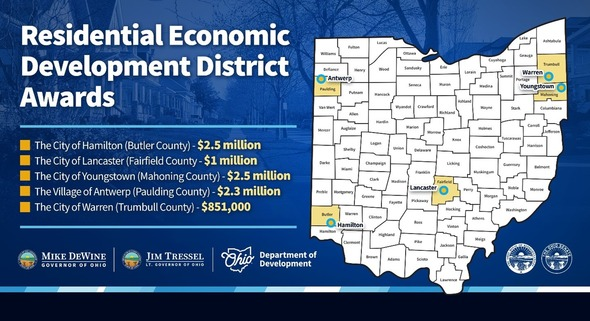
A total of $9,198,019 is being awarded to the following communities:
The City of Hamilton (Butler County) will receive a $2.5 million grant to support the development of 100 new workforce housing units through the city’s “Build Back the Block” initiative. Funding will be used to connect new homes on 100 infill lots to existing water and sanitary sewer infrastructure, helping bring long-vacant residential parcels back into productive use. The City of Hamilton currently owns more than 250 residential parcels ready for redevelopment, and this investment will allow construction to begin quickly, with the first 10 homes expected in 2026. Once completed, the homes will be sold below construction cost to low- to moderate-income families, helping strengthen existing neighborhoods while expanding homeownership opportunities. This project supports housing demand created by investments from the Amazon.com facility in Monroe and other regional economic development projects.
The City of Lancaster (Fairfield County) will receive a $1 million grant to support the development of 361 workforce housing units through key public infrastructure improvements. Funding will be used for sanitary and water main extensions, new public road construction, sidewalks, and related infrastructure needed to support a large mixed housing development that includes single-family homes, townhomes, and apartments. The City of Lancaster has modernized its zoning code and reduced development fees to support housing growth, and the project builds on an estimated $70 million private development investment already underway. The improvements will help accelerate housing construction while supporting the city’s long-term growth goals. This project supports housing demand created by investments from Anduril and other regional economic development projects.
The City of Youngstown (Mahoning County) will receive a $2.5 million grant to support the development of up to 220 workforce housing units through an infill housing initiative. Funding will be used to improve roads, sidewalks, lighting, and other public infrastructure, while also connecting new homes to existing water and sewer systems. Many of the homes will be built on vacant lots owned by the city and the Mahoning County Land Bank, helping transform underutilized properties into new residential opportunities. Homebuyers will receive a 100 percent, 15-year property tax abatement and be eligible for down-payment assistance through the city’s At Home program. The project is a collaboration between Youngstown, the Youngstown Neighborhood Development Corporation, Mercy Health Youngstown, and other community partners. This project supports housing demand created by investments from the Ultium Cells facility in Warren and other regional economic development projects.
The Village of Antwerp (Paulding County) will receive a $2.3 million grant to support the development of 345 workforce housing units through major infrastructure and roadway improvements. Funding will be used to construct new roadways, drainage systems, sanitary sewer lines, and water infrastructure needed to support a high-density residential development. The Village of Antwerp has established a Priority Workforce Housing District and eliminated development fees to encourage new housing construction. These investments will create a mix of single-family homes, duplexes, and multifamily units while helping address regional workforce housing demand. This project supports housing demand created by investments from First Quality Tissue in Defiance.
The City of Warren (Trumbull County) will receive an $851,000 grant to support the Peninsula Project, which will create 306 new housing units including apartments and townhomes. The funding will be used to modernize water and sewer main lines and upgrade surrounding public infrastructure, enabling higher-density development in the project area. These improvements will support a mix of housing types, including units intended for essential workers earning at or below 80 percent of the Area Median Income. The investment will help prepare the site for construction while advancing Warren’s broader strategy to increase housing availability through infrastructure upgrades and pro-housing policies. This supports housing demand created by investments from Ultium Cells and other regional economic development projects.
“The overwhelming demand we’re seeing for this funding sends a clear message: Ohio’s communities believe in our economic momentum,” said Lydia Mihalik, director of the Department of Development. “Our local partners see the success stories taking shape in their backyards, and their response reflects a shared confidence in Ohio’s future, and a relentless determination to ensure they’re part of it.”
The REDD program was introduced by Senator Michele Reynolds in the state’s biennial budget bill, House Bill 96, and championed by Minority House Leader Dani Isaacsohn and Rep. Adam Mathews in the House. House Bill 96 was signed into law by Governor DeWine last year.
“Workforce housing is essential to sustaining Ohio’s economic momentum,” said Sen. Reynolds. “As our state attracts new businesses and creates new jobs, we must ensure that the people who power our communities—teachers, healthcare workers, first responders, and skilled tradespeople—have access to quality, affordable housing near where they work. I was proud to champion the creation of the REDD program in the state budget because it helps communities prepare for growth and ensures that economic development benefits the people who call Ohio home.”
“This program is about lowering the cost of housing for Ohio families,” said Leader Isaacsohn. “By making it easier and less expensive to build homes, we can increase supply and bring down home prices, mortgages, and rent across our state. When our state lands major economic development projects, families and workers deserve the chance to live in the communities where those jobs are created. This investment in workforce and affordable housing is designed to reduce the cost of construction, expand access to attainable homes, and ensure that Ohio’s economic growth translates into real savings and real opportunity for the people who call our state home.”
“Growing Ohio’s economy and supporting our families requires investment in new housing construction,” said Rep. Mathews. “We crafted this program to promote the adoption of pro-housing policies throughout Ohio, give local communities flexibility in determining which policies best fit their needs, and award grant funding to maximize impact on our housing needs. I am grateful to each of the communities that submitted applications and look forward to this program continuing to support new housing being built in Ohio.”
Local governments located within 20 miles of a major economic development project were eligible to apply for funding to expand housing-related infrastructure, strengthen public safety and community services, or provide capital to support new housing development.
Development received 48 eligible applications for this round of funding, totaling nearly $99 million in requests.